Masterbatch Dosing: Optimal Loading Rates for Cost Efficiency & Quality
Understanding Let-Down Ratios
The let-down ratio (LDR) refers to the amount of masterbatch added relative to the natural polymer. Expressed as a percentage, typical ratios range from 1% to 5%, depending on the masterbatch concentration and desired outcome.
Example: A 2% LDR means 2kg of masterbatch per 100kg of polymer (or 98kg polymer + 2kg masterbatch).
Standard Loading Rates by Application
| Application Typical LDR Notes | ||
| Standard Colors | 2-3% | Most injection molding and extrusion |
| Deep/Dark Colors | 3-5% | Black, navy, dark brown |
| White/TiO2 | 3-6% | Higher for opacity requirements |
| Metallic Effects | 1-2% | Avoid excess to prevent flow marks |
| Additive-Only | 0.5-2% | UV, antistatic, slip agents |
Factors Affecting Optimal Dosing
Pigment Concentration in Masterbatch
Higher concentrate formulations allow lower dosing rates. RSPI offers concentrations up to 70% pigment loading for cost-sensitive applications requiring minimal let-down.
Polymer Melt Flow Rate
The masterbatch carrier should closely match the polymer's MFR for optimal dispersion. Using a higher MFR masterbatch in a low MFR polymer can cause streaking.
Part Geometry
Thin-wall parts may show flow lines with insufficient dosing. Complex geometries with multiple flow paths may require slightly higher loading for uniform color.
Process Type
- Injection Molding: Standard 2-4% works for most applications
- Blow Molding: May require 0.5% higher for wall thickness variations
- Film Extrusion: Lower rates possible due to high shear mixing
- Fiber Spinning: Often 1-2% due to high draw ratios
Dosing Equipment Best Practices
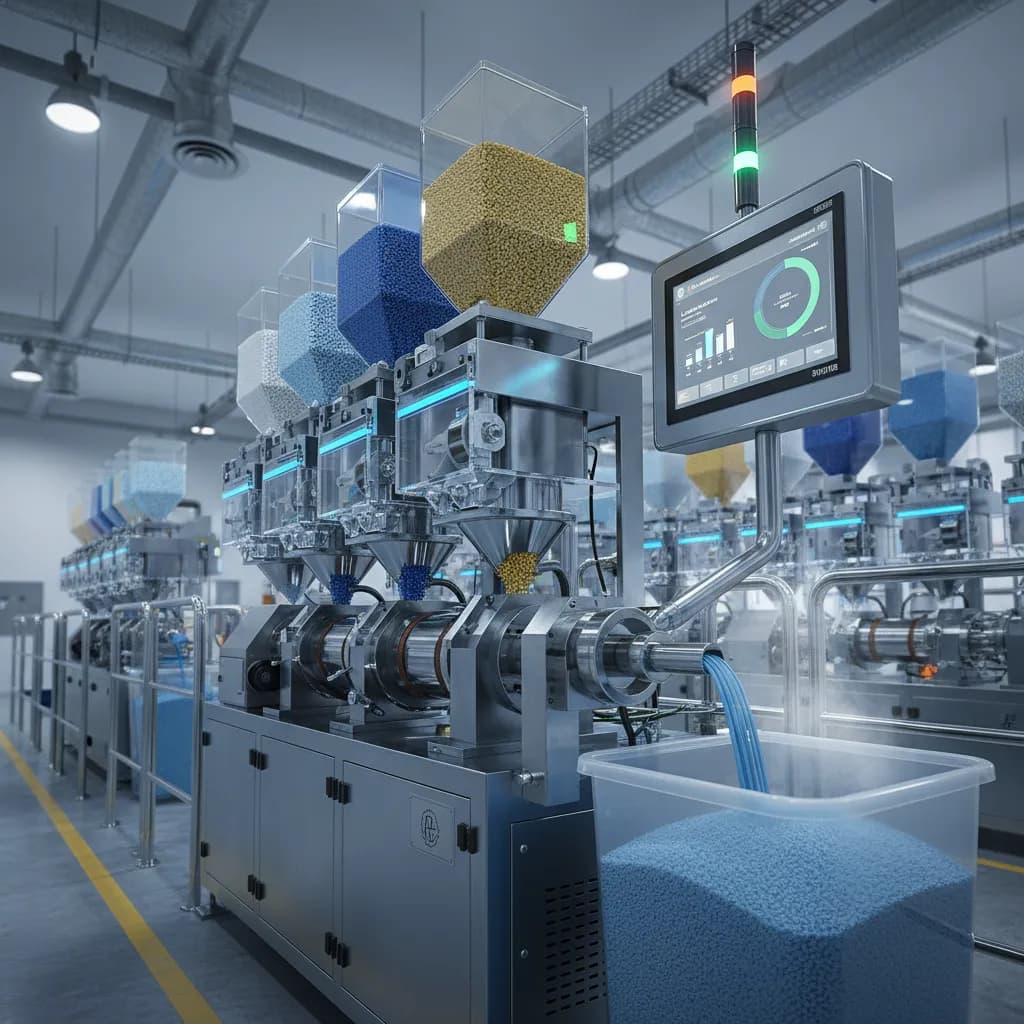
- Calibrate gravimetric feeders at least weekly
- Use loss-in-weight systems for critical color applications
- Ensure hopper is always minimum 25% full to maintain consistent flow
- Clean feeders thoroughly between color changes
- Verify masterbatch pellet size matches polymer pellets (±20%)
Troubleshooting Common Dosing Issues
Color Too Light
First verify feeder calibration. If accurate, increase LDR in 0.5% increments until target reached. Consider requesting a higher concentration formulation if at maximum process capability.
Streaking or Uneven Color
Often indicates insufficient mixing. Increase back pressure (injection) or screw speed (extrusion). If persistent, the masterbatch carrier may be incompatible with your base polymer.
Color Variation Between Batches
Ensure masterbatch is from same production lot. Implement residual masterbatch purging between material changes. Consider pre-mixing masterbatch with polymer before hopper loading.
Cost Optimization Strategies
- Request higher concentrate formulations to reduce shipping and storage costs
- Work with your masterbatch supplier on custom formulations optimized for your specific process
- Implement automated dosing systems for reproducibility and waste reduction
- Track actual vs. theoretical consumption to identify process drift
Conclusion
Optimal masterbatch dosing balances color quality, cost efficiency, and process stability. Working closely with your masterbatch manufacturer to fine-tune loading rates for your specific applications delivers consistent results and maximizes your return on investment.